
Individual return streams
Different strategies. Different paths.
Uncorrelated strategies. One portfolio.
Portfolios designed for markets we can’t predict.
We combine uncorrelated strategies in our equities and crypto portfolios, so performance is not dependent on any single market condition.
220+ strategies across equities and crypto. Monthly performance reports.
 Pavel KycekCEO & Co-founder, Robuxio
Holding one approach is a bet on one kind of market. We built our portfolios to take luck out of the equation.
Every approach earns in the conditions it was built for. Combine enough uncorrelated ones, and the portfolio stops needing any particular conditions to perform.
Different Strategies For Different Market Conditions
No strategy performs in every environment. The portfolio combines approaches designed to respond differently as conditions change.
Strong bull market
Momentum and trend strategies capture sustained upside.
Sideways / choppy
Mean reversion harvests short-term dislocations.
Bear market
Shorts and hedges protect capital and profit from downside trends.
Sudden shock
Hedges and predefined risk limits reduce tail losses.
No Single Strategy Carries The Portfolio
The strategies are grouped into uncorrelated return sleeves and no sleeve is allowed to dominate the portfolio. Strategy weights are chosen based on long-term robustness of the portfolio, free from any recent performance bias.
The largest sleeve is about a third of the exposure, and its worst drawdown is 4.1%. Nothing here is big enough to decide the outcome on its own.
Returns In Different Market Environments
Each sleeve captures a distinct source of return. Low return correlation and limited drawdown overlap reduce the portfolio’s reliance on any single sleeve.
Swipe to see all strategy pairs
| Momentum | 0.16 | |||||
|---|---|---|---|---|---|---|
| Tactical Alloc. | 0.29 | 0.38 | ||||
| Real Assets | 0.12 | 0.23 | 0.33 | |||
| Short-Term | 0.44 | 0.28 | 0.42 | 0.13 | ||
| Crisis Hedging | −0.07 | −0.07 | −0.11 | −0.06 | 0.01 | |
| S&P 500 | 0.28 | 0.18 | 0.29 | 0.09 | 0.34 | −0.21 |
| Mean Reversion | Momentum | Tactical Alloc. | Real Assets | Short-Term | Crisis Hedging |
Exposure That Changes With Market Conditions
Each portfolio can increase, reduce, or hedge its market exposure as individual strategy exposure is dynamic and responds to changing conditions.
Beta to the S&P 500 averages 0.32 (about a third of the market's movement), and it moves with conditions rather than sitting still.
Holding S&P 500
Fixed by definition
Robuxio Equities
Moves with conditions
Up With The Market, Not Down With It
Each portfolio seeks to participate when its market rises while reducing dependence on that same market when it falls.
Markets can offer opportunities in both directions. Our strategies aim to generate returns whether markets rise or fall. The chart shows how Robuxio performed, on average, in each type of month.
Months the market rose
149 of 224 months
Months the market fell
75 of 224 months
Drawdown Depth Changes The Compounding Path
Limiting the depth of losses leaves more capital in place to compound when conditions improve. Quiet periods are part of the design: through a low-volatility stretch the portfolios can sit close to flat, and when conditions change they can take positions more aggressively again.
One Allocation With Multiple Approaches
Uncorrelated strategies share one capital pool, so the same capital works across every approach. This can smooth returns, reduce drawdown depth and duration, as well as create a more consistent path for compounding.
- Passive market exposure
- A market-neutral fund
- A trend programme
- Tail-risk hedging
- Several managers, several fee layers, and capital committed separately in each.
- One capital base.
- One fee layer.
- One allocation decision.
Every strategy draws on the same capital pool. Equities as an exchange-traded instrument, available through your broker or bank. Crypto as a managed account, through BIT prime brokerage, or in the fund.
What Would A Systematic Layer Do For Your Portfolio?
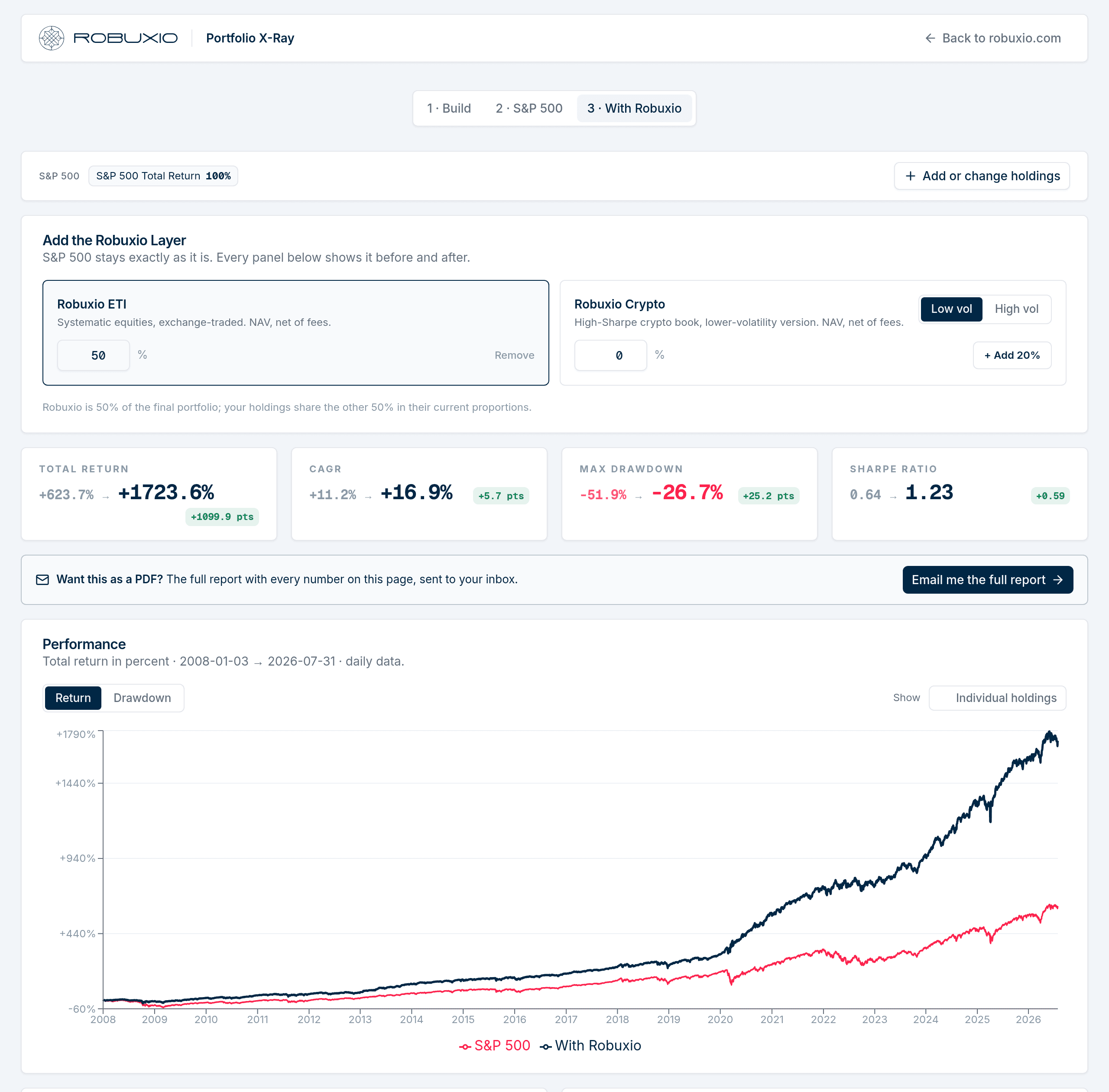
Enter your current allocations and dive into the numbers. Compare returns, drawdowns, behavior under stress. Then add a systematic allocation to your portfolio to see exactly what changes.
Free and interactive. It takes about two minutes, and the full analysis lands in your inbox as a detailed report.
The Systematic Approach, In Two Markets
One systematic engine trades crypto, equities, and index and sector ETFs. The method is identical on both sides. Pick the market your capital is in to see how it runs there.
Systematic Exposure To Crypto
25+ uncorrelated strategies, long and short, built to compound across bull, sideways, and bear regimes.
The Crypto Story →Systematic Exposure To Equities
Six uncorrelated return sleeves with dynamic market exposure, packaged as an exchange-traded instrument (ETI), available through your broker or bank.
The Equities Story →€100k And Above
Chat With Our Team
Larger allocations are discussed directly: vehicle selection, mandate parameters, and the operational route that fits.
Before you invest
Your questions, answered.
Start with the shared approach, then read the details for equities or crypto. Access, custody and fees depend on the route you choose.
Shared approach
Are equities and crypto combined in one portfolio?
No. Robuxio Equities and Robuxio Crypto are separate portfolio offerings. They share the principle of combining different systematic strategies, but trade different markets and have their own return histories, risks and access routes. Choosing the equities ETI does not give you the crypto portfolios, or vice versa.
Compare equities and cryptoWhat is systematic investing?
Systematic means using predefined rules to decide what to trade, when to trade and how much exposure to take. This applies to both Robuxio Equities and Robuxio Crypto. The strategies and instruments differ between them, but both use a researched, repeatable process with ongoing monitoring.
See the shared approachHow does a multi-strategy portfolio work?
Each Robuxio portfolio combines strategies that look for different opportunities. For example, momentum follows sustained price moves while mean reversion looks for reversals. Different strategies can perform well at different times, making the combined result less dependent on one approach. The strategy mix is specific to each portfolio.
See how strategies work togetherHow is strategy diversification different from owning many assets?
Holding many stocks or cryptocurrencies spreads exposure across assets, but those assets may still rise and fall together. Strategy diversification also varies how returns are generated, using different trading rules and opportunities. Both Robuxio offerings apply this principle within their respective markets. It can reduce dependence on a single return source, but cannot eliminate losses.
Compare with passive benchmarksCan the strategies make money when markets fall?
Both equities and crypto portfolios include strategies that can seek returns during market declines, including short positions. Other strategies look for rebounds or temporary price dislocations. Their roles and weights differ by portfolio. This creates opportunities in both directions, but does not mean either portfolio will profit in every falling market.
Compare behaviour in different marketsAre both portfolios market-neutral?
Neither offering should be treated as having no exposure to market direction. Both combine different return sources, including strategies with directional positions. The size and direction of that exposure change over time and differ between portfolios. Compare the correlation, market sensitivity and drawdowns for the specific equities or crypto portfolio you are considering.
Explore the comparisonsWhat does drawdown tell me about a portfolio?
Drawdown measures the decline from a previous portfolio high to a later low. Its depth shows how much value was lost, while recovery time shows how long it took to regain that high. Consider both alongside returns and volatility. The largest historical drawdown is not a limit on future losses.
Compare returns and drawdownsWhat does low correlation mean for my existing portfolio?
Low correlation means two return histories have tended to move less closely together over the measured period. That can make combining them useful, but correlations change and may rise during stress. The Portfolio X-Ray lets you explore the historical effect of adding a Robuxio allocation to the portfolio you already hold.
Try the Portfolio X-RayWhere can I check the results for each portfolio?
The reports hub has separate equities and crypto reports. Use the report for the portfolio you want to assess, then compare its return and risk history with the relevant benchmark. The equities ETI also has an exchange listing and a dedicated structure page; those relate to the equities security, not to crypto accounts or the crypto fund.
Read the latest reportsHow does a high-water mark performance fee work?
A high-water mark is the level an account or investment must exceed before another performance fee is earned. It helps avoid charging a performance fee again just for recovering previous losses. It is a fee rule, not a return target or a promise to recover losses. The calculation and settlement schedule depend on the specific ETI, crypto account or fund terms.
Compare portfolio access routesEquities ETI
How do I invest in Robuxio Equities through my broker?
Search your bank or broker for ISIN DE000AMC0DZ1. The Robuxio Equities ETI is listed on Börse Stuttgart and is held in your securities account. Availability depends on your broker and jurisdiction. The buying guide explains the order process and what to do if your platform does not show the instrument.
Read the buying guideWhat is an ETI, and is it the same as an ETF?
ETI means exchange-traded instrument. The Robuxio ETI is a listed security linked to an actively managed reference portfolio. It is not an ETF: its issuer, security arrangements and legal structure are different. Review those arrangements as well as the investment strategy when deciding whether the product fits your needs.
Understand the ETI structureWho holds the assets behind the equities ETI?
The underlying assets sit in a dedicated segregated portfolio, with Interactive Brokers providing custody and execution. iMaps ETI AG is the issuer, and the structure includes an independent security trustee for noteholders. Your ETI holding appears in your own broker or bank account. The structure page explains each participant and its role.
See the custody and issuer mapWhat is the minimum for the equities ETI?
The ETI can be bought from one unit, subject to your broker’s order requirements. The initial issue price was EUR 1,000 per unit; that is not a fixed current purchase price. Your cost depends on the available market quote and broker charges. The crypto account minimums do not apply to the ETI.
Check how to buy the ETIWhat fees apply to the equities ETI?
The equities product page lists a 2% annual management fee and a 20% performance fee on new net profits, with a high-water mark. The published portfolio NAV is net of fees. Your broker may also charge dealing or currency-conversion fees, and the market quote includes a bid-ask spread. Read the current product terms before placing an order.
Read the equities product termsHow do I exit the equities ETI?
You sell your ETI units through your bank or broker on the exchange. Execution depends on market hours, available quotes and your order conditions. This is a sale of a listed security, rather than a withdrawal from a crypto exchange account or a redemption from the crypto fund.
Read the ETI dealing guideCrypto access
How does a direct-exchange crypto account work?
With the direct-exchange route, your assets stay in your own supported Binance or Bybit account. Robuxio receives trading-only API permissions to run the agreed portfolio and cannot withdraw through those permissions. You keep account ownership and withdrawal rights. The exchange still holds the assets, so exchange custody risk remains. This setup applies to crypto, not to the equities ETI.
Learn about managed accountsCan I access the crypto portfolios through prime brokerage?
Yes. BIT prime brokerage is a separate crypto access route from connecting your own exchange account directly. Its published minimum is $50,000, compared with $100,000 for direct exchange. Account setup, portfolio availability and profit-sharing schedules differ. The trading-only API description for direct exchange should not be assumed to describe the BIT custody arrangement.
Compare crypto access routesWhat is the difference between a crypto SMA and a pooled fund?
A direct-exchange crypto account runs the agreed strategies in your own exchange account. A pooled fund combines investors’ capital inside a separate vehicle, where you hold an interest in the fund rather than operate that exchange account yourself. Robuxio Capital Management offers the pooled route to eligible qualified investors, with its own custody, fees and redemption terms.
Review the fund routeWhat are the minimums for crypto access?
Direct-exchange access starts at $100,000. BIT prime brokerage access starts at $50,000. The pooled fund has a separate eligibility and onboarding process; confirm its minimum for the relevant share class with the team. These are crypto access terms and do not apply to the equities ETI.
Compare crypto account routesAre the crypto charts net of the fees I would pay?
No. The main crypto portfolio charts show gross asset value, before the fees specific to your access route. Direct-exchange accounts, BIT access and the pooled fund have their own fee terms and settlement arrangements. Use those terms to understand your net result; do not apply the equities ETI fee schedule to a crypto chart.
Read the crypto performance basisHow do withdrawals work for crypto accounts and the fund?
With direct exchange, you retain withdrawal rights in your own account, but should coordinate changes around open positions and margin requirements. BIT access follows the applicable platform and account terms. The pooled fund uses the redemption schedule and notice periods in its documents. These are different arrangements, so confirm the terms for your route before funding.
Review crypto account arrangements