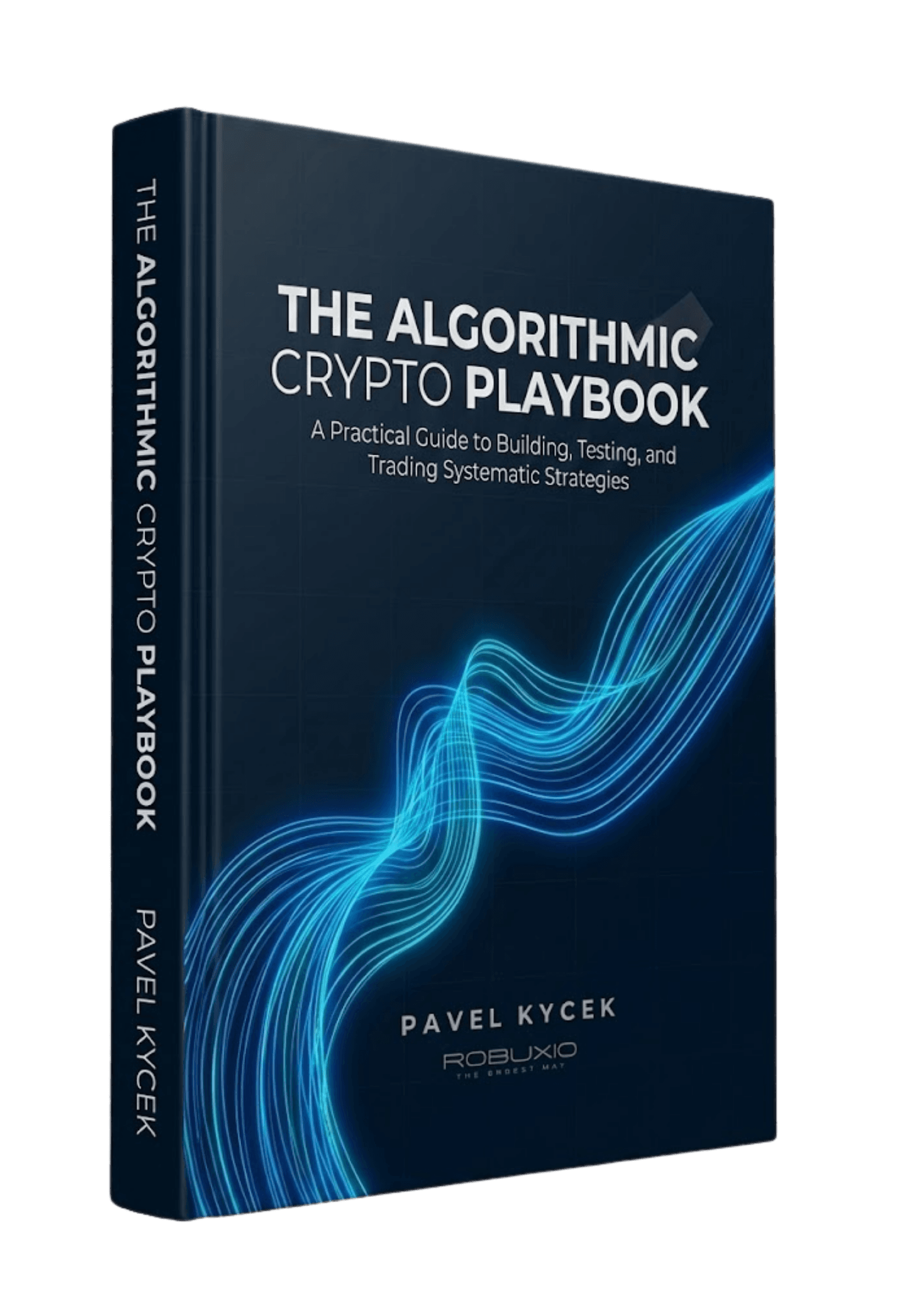
The Algorithmic Crypto Playbook
A Practical Guide to Building, Testing, and Trading Systematic Strategies
by Pavel Kycek
New — Agent Edition
Buy a copy for your AI agent
Most people never finish a trading book. Your agent will. The whole playbook, packaged as a skill your agent consults while you build — instead of a PDF you meant to read.
Works with
 Claude Code
 Codex
Codex Cursor+ any agent that reads files
Worked for 0.0s · 5 files read
Short-term, not long-hold. The book treats breakout as a momentum burst — hours to days, not weeks. Crypto bursts typically last 1–3 days, so holding longer gives the move back.
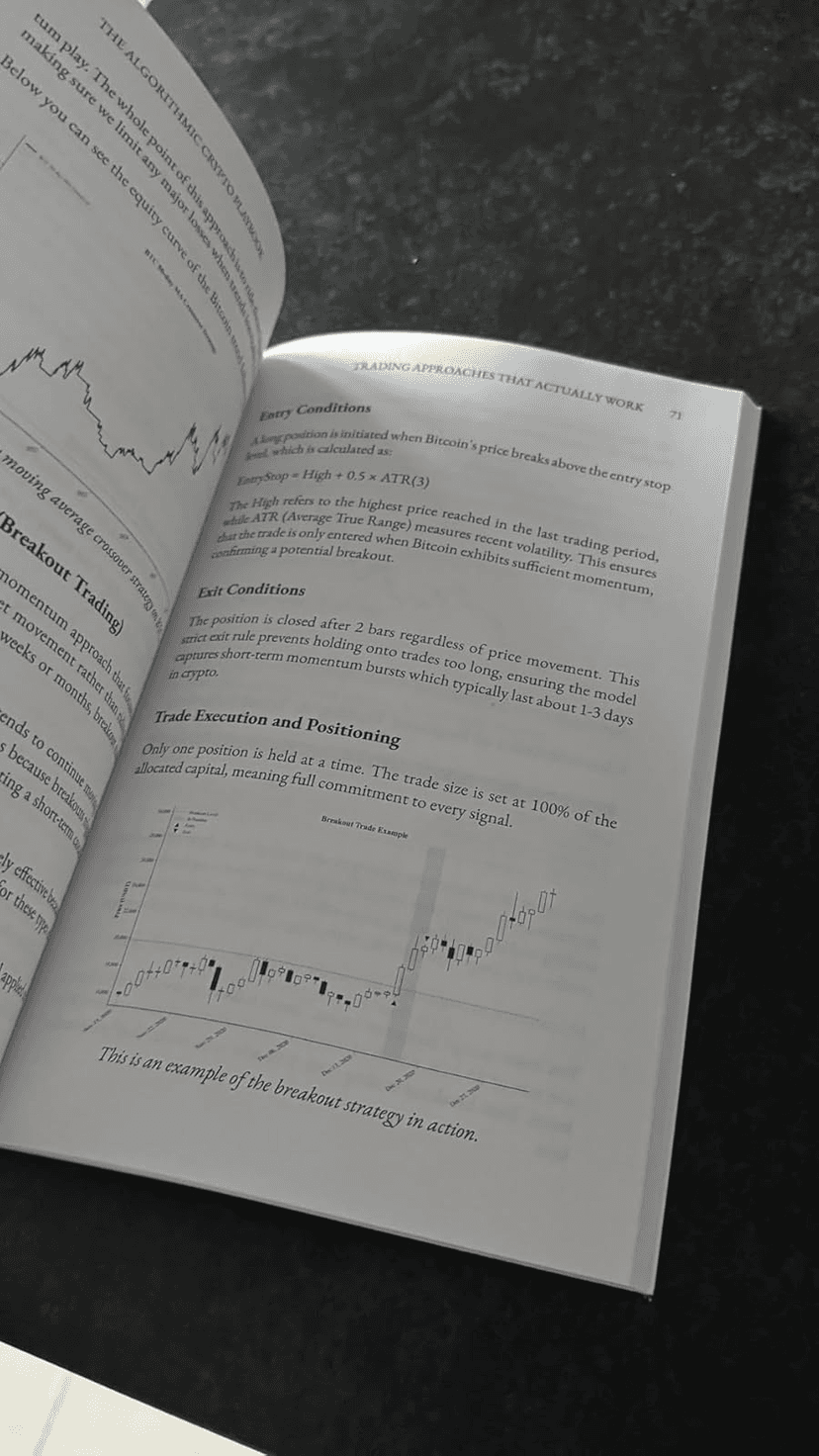
Its simplified BTC model: EntryStop = High + 0.5 × ATR(3) · exit after 2 bars · one position at a time.
Expect a ~50% win rate (vs 30–35% for trend following), and run it alongside trend following — breakout catches the bounces that trend systems sit out during consolidation.
— The Algorithmic Crypto Playbook, ch. 4
A real question, answered from chapter 4 of the book.
The Algorithmic Crypto Playbook
Introduction
Investors globally are racing to gain crypto exposure after witnessing Bitcoin’s extraordinary returns over the last decade. U.S. spot Bitcoin ETFs attracted $116 billion in inflows by the end of 2025, with BlackRock’s iShares Bitcoin Trust capturing the majority of institutional capital and becoming the third-largest ETF globally in its first year. The allure is undeniable, Bitcoin has delivered life-changing wealth to early investors.
What most people don’t realise is that Bitcoin is maturing as an asset, and its volatility (the very characteristic that drove those massive returns) is steadily declining.
To replicate those past gains, many investors are now turning to the broader crypto market, often assuming that the same buy-and-hold approach that worked for Bitcoin can deliver similar results across the broader Altcoin market. This assumption is not just wrong, it has proven detrimental financially.
The Harsh Reality of Crypto Investing
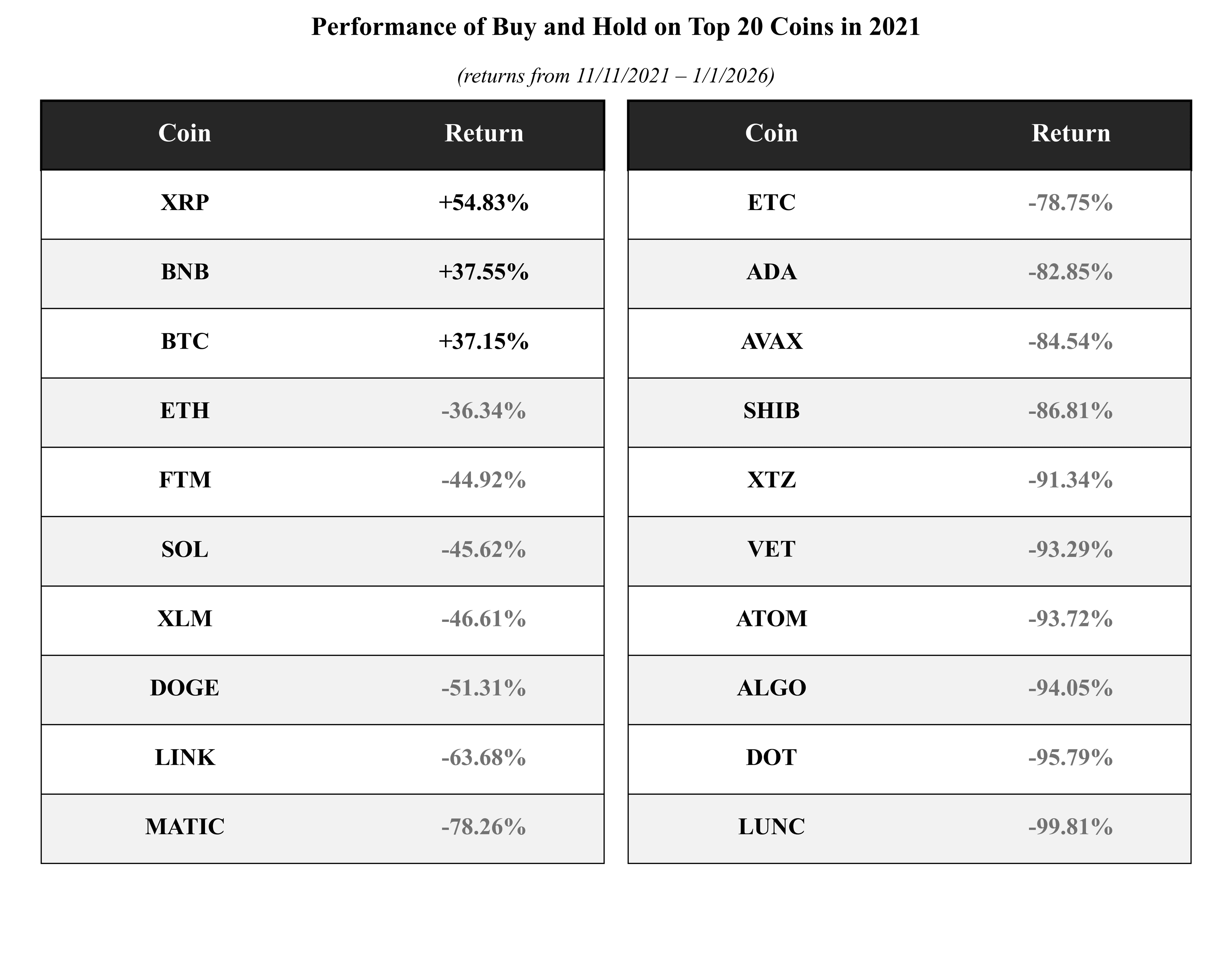
Historical data tells a clear story. Buy-and-hold strategies have consistently failed when applied to the broader crypto market. Most coins suffer massive drawdowns from which they never recover.
If you had bought the 20 largest cryptocurrencies at their peak in late 2021, only three would have recovered to positive returns by now. The rest are in deep drawdowns ranging from 36% to complete wipeouts.
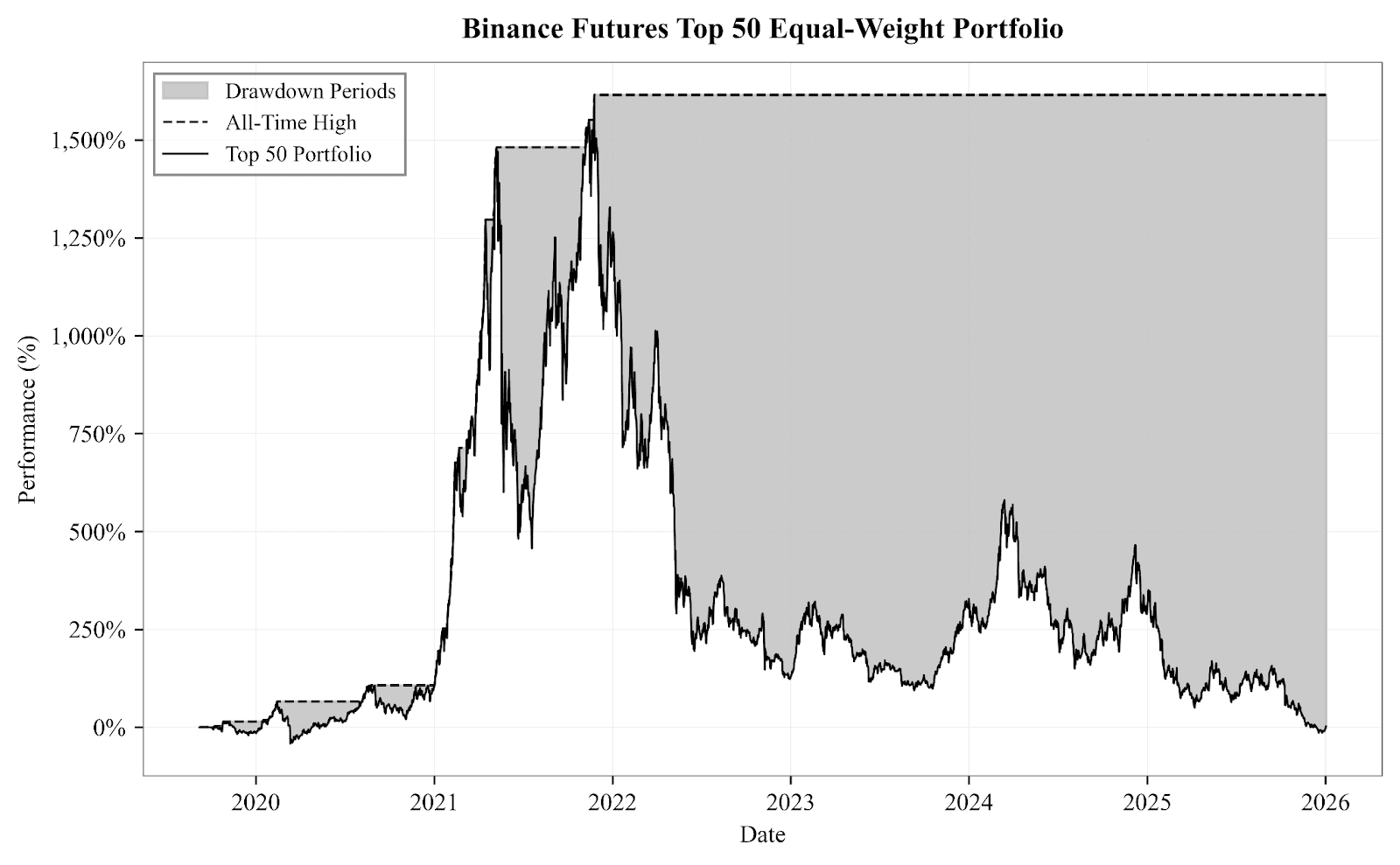
The results become even worse when you examine broader market indices. The Top 50 Binance Futures Index, a daily-rebalanced, equally weighted basket of the top 50 crypto futures by volume and liquidity, tells the complete story. Most coins never recover after large drawdowns and eventually fade into obscurity or go to zero entirely.
This is the fundamental nature of how most crypto projects evolve. The vast majority of cryptocurrencies lack real-world utility, sustainable business models, or transparent governance. They’re fueled by speculation, hype cycles, and market manipulation, leading to severe drawdowns that wipe out uninformed investors.
This volatility and instability make the crypto market in its current form, an unreliable asset class for long-term investment. Yet despite this reality, the broader crypto market offers something unprecedented.
The Hidden Opportunity
While buy-and-hold strategies destroy capital in crypto, the same characteristics that make them unsuitable for passive investing (extreme volatility, persistent inefficiencies, and emotionally driven participants) make crypto ideal for algorithmic trading.
Crypto remains one of the most volatile and inefficient asset classes in the world. Daily price movements of the top 50 crypto futures are often 5–10 times larger than major equity indices.
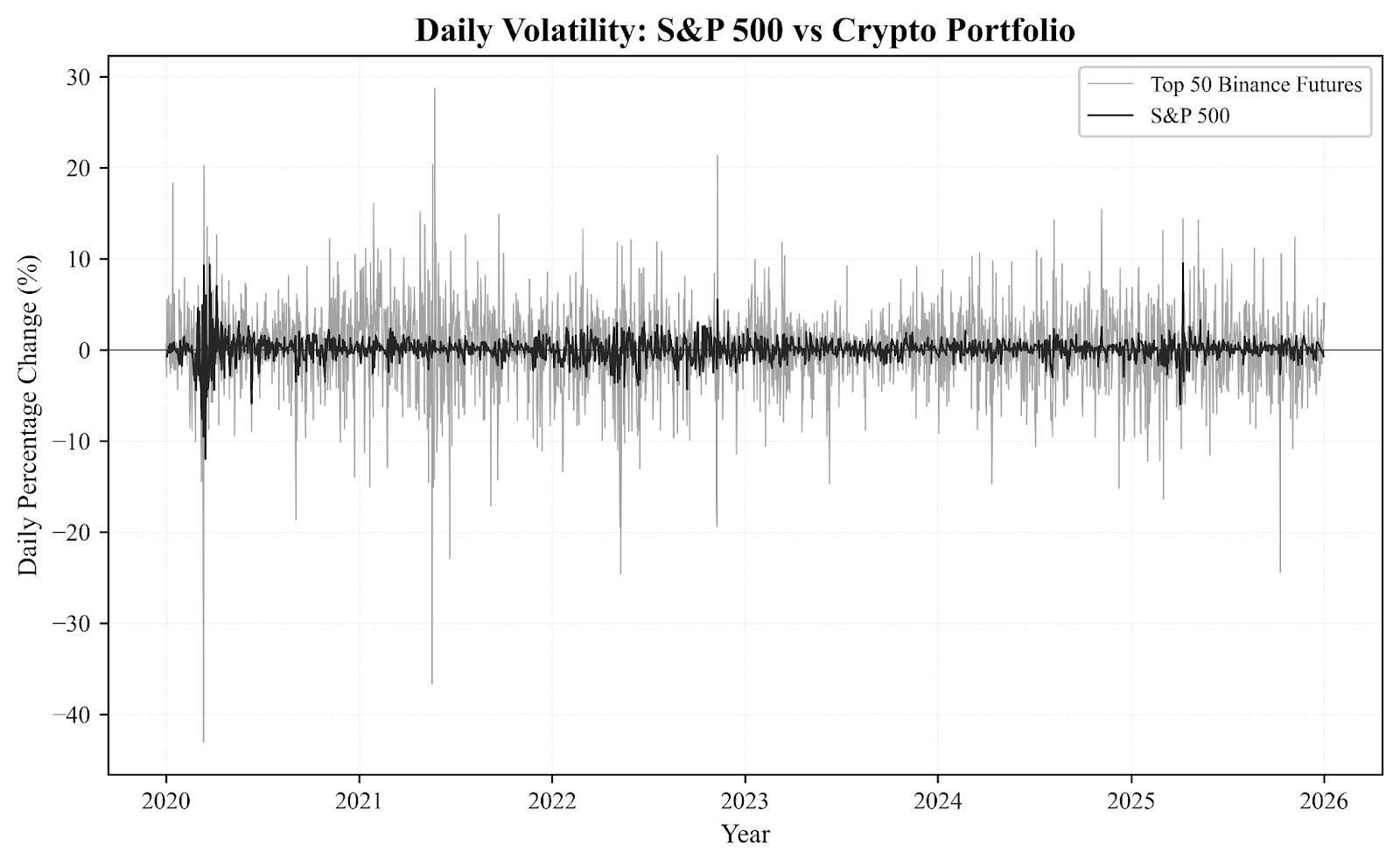
For traditional investors, volatility represents risk. But for algorithmic traders, volatility represents profit potential. Larger price swings create more frequent and more profitable trading signals.
The emotional participants in crypto markets make classic mistakes driven by fear and greed. Panic selling creates oversold conditions that tend to reverse. Fear of missing out creates overbought conditions that tend to correct. These behavioral patterns repeat consistently because human psychology doesn’t change, even when the asset class is new.
This combination of high volatility, structural inefficiencies, and behavioral mispricings creates a rare and time-sensitive window. As crypto matures, these inefficiencies will fade, just as they have in traditional markets over decades of institutional participation.
But right now, today, crypto offers something that sophisticated traders rarely find: an inefficient market environment where algorithmic approaches can generate outsized returns by capturing short-term price dislocations rather than betting on any particular project’s long-term success.
My Journey to Algorithmic Crypto Trading
My name is Pavel Kýček, and I have been trading for over two decades.
When I started trading at 18, I was convinced I possessed some special insight that would allow me to beat markets quickly. Like most beginners, I significantly overestimated my competence while underestimating the market’s complexity.
For seven painful years, I lost consistently.
The breakthrough came when I stopped trying to predict what markets would do and started building systems that could profit regardless of market direction. The key was realizing that instead of fighting the market’s unpredictability, I needed to systematically capture it.
That shift led me toward algorithmic trading based on historical price data. I could test any idea against years of market behavior and see exactly how my strategy would have performed. This gave me something prediction never could, namely, statistical confidence about probable outcomes.
The transformation took years. Moving from losing trader to consistent profitability required not just better systems, but better psychological discipline. The hardest part wasn’t building algorithms, it was actually learning to trust them during losing streaks.
Today, I co-manage Robuxio alongside my partners Dries and Xavier. We provide automated algorithmic trading strategies for institutions and serious investors. As we have grown rapidly over the past few years, I feel the deep need to give back to people who are at an earlier stage on their journey to becoming profitable traders. Hence, why I am writing this book.
The Algorithmic Approach
What if instead of trying to predict market direction, you built systems that profit from specific market behavior? What if you stopped hoping for one type of market and started preparing for all types?
This book teaches you to develop multiple systematic trading approaches that generate profits across different market environments. Not through prediction, but through statistical edges identified in historical data and executed with discipline.
A trading edge is an advantage that allows a trader to make consistent profits over time. As markets evolve, however, it becomes increasingly difficult to maintain that edge. This isn’t random, it follows a predictable pattern as markets mature. This book will help you understand what edges are available to you and how to exploit them.
You’ll build systems with specific entry and exit rules, test them against survivorship-bias-free historical data, and know (before risking real money) what probability of success you have. You’ll understand expected drawdowns, which market conditions favor which systems, and have statistical confidence rather than emotional hope.
More importantly, you’ll learn to combine these systems. Individual strategies have losing periods (it’s inevitable). But when you run multiple approaches simultaneously, designed for different market conditions, the combined portfolio generates returns even when individual components struggle. When markets trend, your trend-following systems profit. When they chop, your mean reversion strategies capitalize. You’re not betting on only one scenario. You’re preparing for all of them.
Once your systems are operational, emotion largely disappears from trading, not because you stop caring, but because you finally understand what’s happening. Your computer executes algorithms built on your rules and risk parameters. You’re not glued to screens, anxiously watching every tick. If you’re making money, you know why. If you’re losing money, it’s equally clear. The system is not aligned with the current market regime. There’s no invisible enemy that you don’t fully understand and no manipulation narrative that you are fighting against.
Contrast this with discretionary trading without a system. When expectations are vague and biases creep in, every loss feels personal. The market feels “against you,” and it’s easy to blame social media narratives about manipulation. A systematic approach removes that noise. You replace hope and frustration with an understanding of market behavior, and how you can systematically profit from it. That understanding brings emotional calmness. The mental freedom alone is worth the upfront work.
Your Journey Starts Now
By the end of this book, you’ll have the tools to design, test, and implement trading strategies tailored to your personal goals and risk tolerance. Most importantly, you’ll have the confidence that comes from understanding exactly why your strategies work and when they don’t.
Financial markets present incredible opportunities to build lasting wealth. But those opportunities come with corresponding risks for those who approach them unprepared. The question isn’t whether opportunities exist in the markets, it’s whether you’ll be prepared to capture them systematically and profitably.
You can spend years making the same mistakes I made, losing money and confidence along the way. Or you can learn from those who have already walked that painful path and come out the other side with approaches that work.
In the chapters that follow, is everything I wish I’d known at the beginning. Let’s get into it.
Chapter 1
Why Most Crypto Traders Fail
The vast majority of retail traders don’t just underperform, they lose money. Consistently.
While difficult to measure across every market participant, the industry often cites the 90-90-90 rule, which states that 90% of traders lose 90% of their capital within 90 days of trading. From my experience, this is the sad reality.
I know this, because I was part of that majority for many years.
At 38 years old, I’ve been trading for two decades, starting when I was just 18. Those first seven years were painful. I lost money consistently, made every mistake imaginable, and came close to quitting multiple times. The losses weren’t just painful financially, they also had a large impact on my psychological and emotional state.
Looking back, my early struggles weren’t due to lack of intelligence or effort. I was smart enough. I worked hard enough. I was obsessed with learning about trading. The problem was that I was learning the wrong things from the wrong sources. I was consuming the kind of misguided advice that dominates trading content. The type of advice designed to make trading look simple and exciting rather than actually help traders succeed.
I approached markets with confidence that vastly exceeded my competence. I believed I could see patterns others missed. I thought my ability to analyze information in other areas of life would translate directly to trading success. I was convinced I’d be profitable within months, maybe a year at most.
I was wrong.
What changed everything wasn’t finding some secret indicator or magic strategy. It was finally understanding why I was failing, and more importantly, why most traders fail. Once I grasped the fundamental reasons behind widespread trader failure, I could address them systematically rather than continuing to bang my head against the same walls.
The reasons traders fail aren’t mysterious. They aren’t hidden. They’re just uncomfortable truths that most trading content refuses to address, because uncomfortable truths don’t sell courses or build large social media followings.
The reality is trading is difficult. Not because it requires specialized knowledge that only geniuses can master. But because it requires you to operate in one of the most competitive environments that exists, where your natural psychological tendencies actively work against you.
Before we dive into strategy development, we first need to discuss why trading is so difficult, why the approaches most people use are designed to fail, and why systematic approaches offer the most realistic path to consistent profitability.
The Illusion of Simplicity
Crypto trading looks deceptively easy.
Open any social media platform and you’ll see it yourself. Charts moving up and to the right, success stories of twenty-somethings retiring early, and influencers showing off Lamborghinis supposedly bought with trading profits.
The barrier to entry couldn’t be lower, anyone with $100 and a smartphone can start trading within minutes. The interface of many crypto exchanges is clean and intuitive. Just click buy when the price is low, click sell when it’s high. It sounds simple.
But this illusion of simplicity is a trap, and it catches nearly everyone.
What you don’t see behind those success stories is the graveyard of failed traders. You don’t see the sleepless nights, the margin calls, and the mental breakdowns. The crypto space actively promotes this illusion because simplicity and certainty sells. Complexity and uncertainty doesn’t.
Here’s what actually happens when most people start trading crypto:
They open an account during a bull market when prices are rising. Everything they touch seems to make money. They mistake a rising tide for trading skill. They increase their position sizes. They add leverage. They tell their friends they’ve “figured it out.” Then the market turns (and it always turns) and suddenly their account gets liquidated, leaving them with nothing. Those that didn’t get liquidated sell at the bottom, convinced crypto is a scam, or they hold forever, becoming what the community mockingly calls “bag holders.”
The hidden complexity beneath crypto’s simple surface creates challenges that traditional traders rarely face.
The 24/7 Trap
Traditional markets close. The New York Stock Exchange operates 9:30 AM to 4:00 PM Eastern Time. Even forex markets, while operating five days a week, have reduced weekend activity. These closures provide natural breaks where traders can step away, think clearly, and avoid impulsive decisions.
Crypto never stops. Markets operate every hour of every day. Bitcoin doesn’t care if it’s 3 AM on Christmas morning, trading continues, prices move, and opportunities (or losses) emerge constantly.
For manual traders, this creates difficult conditions. You can’t monitor markets around the clock. You need to sleep. But while you sleep, major price movements can occur. You wake up to discover your position moved 15% against you overnight, or worse, you set an alert on your phone and wake up in a panic at 2 AM trying to make rational decisions while half-asleep.
This constant availability creates perpetual fear of missing out and anxiety. There’s always something happening. Always a coin pumping. Always an “opportunity” you’re missing. This psychological burden is exhausting and leads to impulsive, emotion-driven decisions.
Extreme Volatility Is a Double-Edged Sword
Crypto consistently experiences deeper drawdowns than any other major asset class. The chart below demonstrates that crypto corrections often exceed 70%.
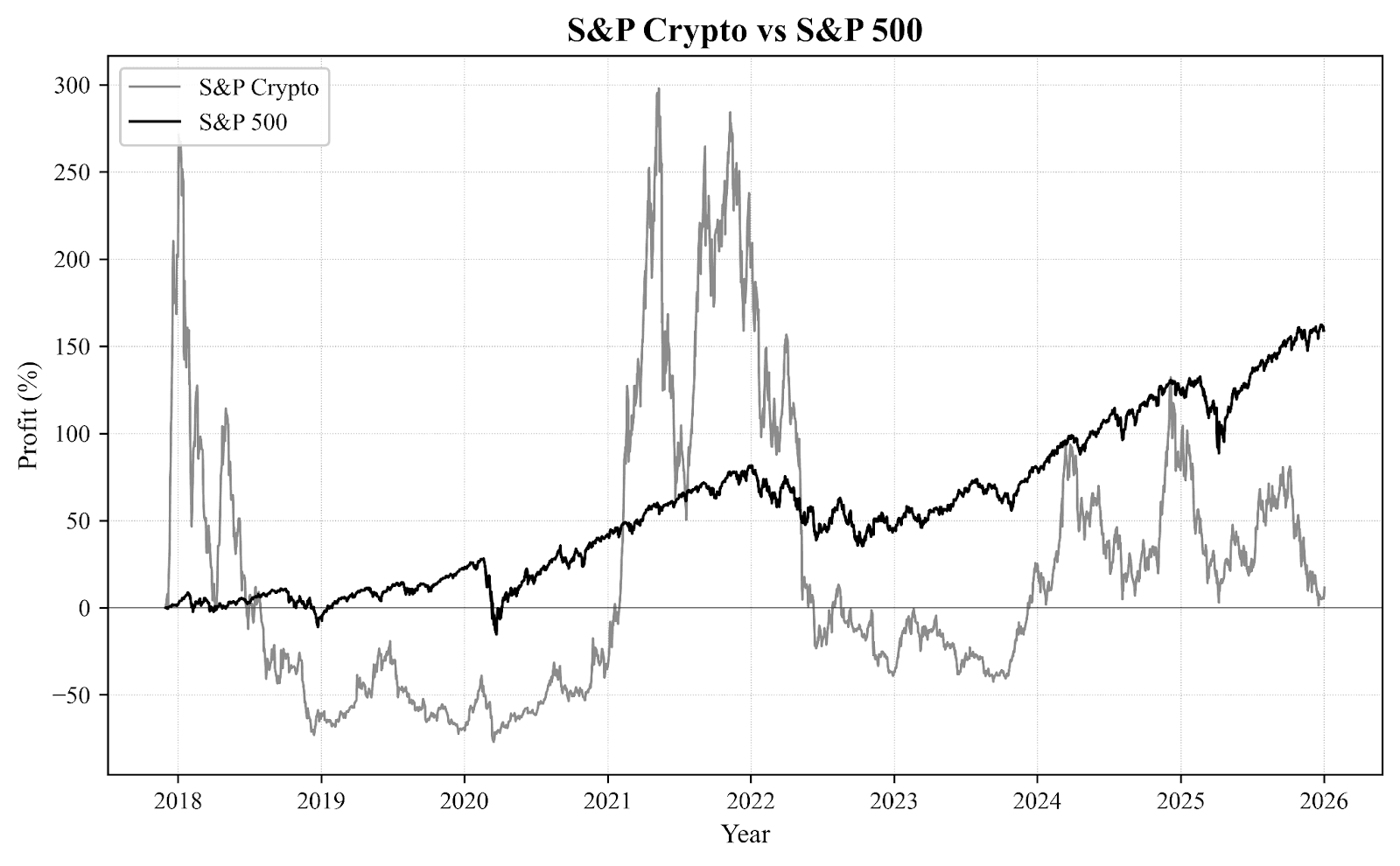
Daily price movements in crypto are 5–10 times larger than major equity indices. A 5% daily move in Bitcoin is unremarkable. In the S&P 500, it would be headline news. For Altcoins, 20–30% daily swings occur regularly during volatile periods.
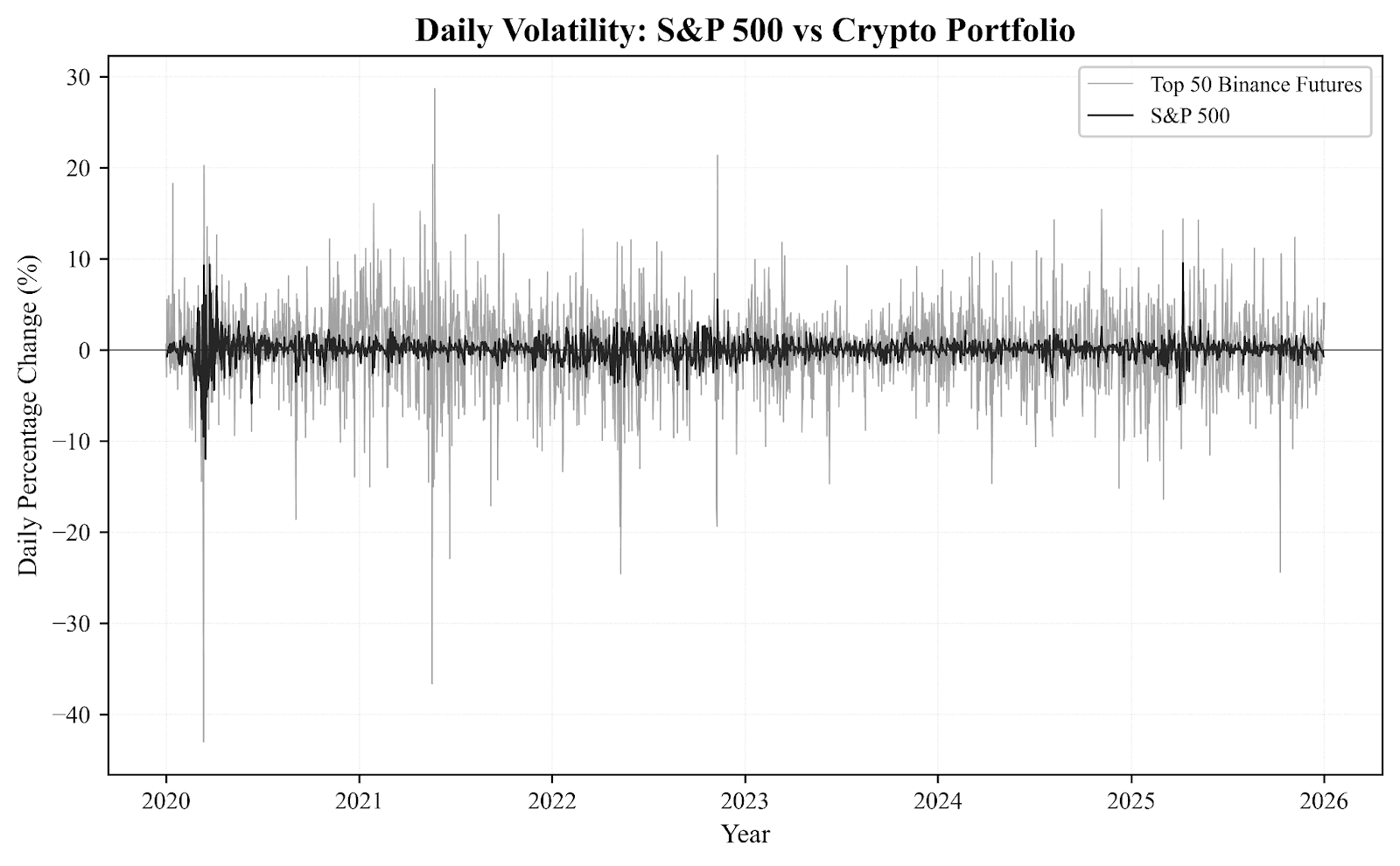
For traditional passive investors accustomed to stock market behavior, this volatility is often psychologically intolerable. They watch their account value fluctuate wildly, triggering emotional responses that defy rational decision-making.
But volatility itself isn’t the problem. Volatility creates opportunity. The problem is how traders respond to volatility emotionally rather than systematically. We will discuss how to harness this in more detail later.
The Social Media Amplification Effect
Crypto trading is inseparable from social media. X (formerly Twitter), Discord, Telegram, Reddit, these platforms drive sentiment, spread narratives, and create hype cycles. Influencers with large followings can move the price of smaller coins with single tweets. Projects organize coordinated “campaigns” to pump their tokens.
This environment creates several problems for discretionary traders.
There’s too much information on social media, and most of it low-quality noise. Traders spend hours scrolling through X looking for “alpha” (profitable insights), finding instead a mix of legitimate analysis, scams, pump-and-dump schemes, and opinions disguised as facts.
When everyone on your feed is buying a coin, fear of missing out becomes overwhelming. You convince yourself that if you don’t buy now, you’ll miss the move. This herd behavior creates bubbles that inevitably pop, leaving latecomers “holding bags”.
Influencers with large followings can manipulate prices of small-cap coins. They accumulate positions quietly, then promote the coin to their followers. As followers buy, prices rise. The influencer sells into the buying pressure, leaving followers with losses.
To make matters more difficult, the dominant narrative changes weekly. One week it’s “DeFi summer.” Next week it’s “NFTs are the future.” Then it’s “meme coins.” Then it’s “AI tokens.” Beginner traders will often chase these narratives, always entering after the smart money is already positioned.
Traditional markets have these dynamics too, but crypto amplifies them. The speed of information flow, the lack of regulatory oversight, and the predominantly retail participant base create an environment where emotional contagion spreads instantly.
What readers are saying
Foundational Read for Algo Traders
This is a fantastic walk through of foundational Algo trading principles. I picked it up out of curiosity as my investing philosophy is the polar opposite of day trading, but it was fun, enlightening and certainly covered what a beginner would need to get started.
Pablo Lema
United States
Great book for any level but especially for the new trader
Just finished the book! It's a concentrated read with not much fluff. Gets right into what will improve any systematic traders outcomes in a logical sequence from mentality, bias, testing, development and validation! The end wraps it all together and it provides you with concepts you can build yourself to test.
Amazon Customer
United States
Must read and implement if trading alt-coins
Read it in a Day — it's a small book packed with vital info. Book gets straight to the point. Explains 3 types of strategies. How to test them for robustness and how to construct strategies for use in a portfolio. The way symbols are systematically chosen. The techniques for testing data in a new market like alt-coins where there isn't much data. I am actually surprised at how much new information I got from this short read. I will definitely be implementing my own versions of the processes and strategies in this book.
MR P.
United Kingdom
An honest and clear book, well worth reading
I'm pretty new to crypto and honestly picked this up expecting another "get rich quick" book. It's not that at all, if anything, it's the opposite. The author is upfront that crypto can wreck you without a real process, which was weirdly reassuring to hear. The biggest thing for me was how it explains momentum and mean reversion strategies without assuming you already know everything. And it keeps hammering home that no strategy works all the time. As a beginner, I needed to hear that. The chapters on risk management and overfitting really stuck with me. I had no idea how misleading backtests could be, or how much psychology messes with trading decisions. That stuff isn't talked about enough.
Jamolpe
Spain
Crypto algorithmic trading goldmine
I saw this book pop-up on Amazon when I was looking for some other books on stock trading. I wasn't expecting much as I am not that familiar with crypto, but I can tell you this a goldmine of insights into everything from "why crypto", to practical methods of building your own strategies. Definitely recommend for anyone looking to level up their algorithmic trading game.
George
Germany
Covers all the foundations
Short reading that explains the basics of algorithmic trading in crypto markets. I found it while looking for different strategies than the ones I usually use in crypto, and I found it very interesting. 100% recommended
Javier
Spain
For all systemic traders this is a GREAT book, do read it!
Blake Carrington
@BankersCandle11
Read it!
Very good introduction to algorithmic trading, especially for crypto. It focusses on the very basic (and important) overlying principals for successfull algorithmic trading. Definitely worth reading!
Yvonne Jakobi
Germany
Foundational Read for Algo Traders
This is a fantastic walk through of foundational Algo trading principles. I picked it up out of curiosity as my investing philosophy is the polar opposite of day trading, but it was fun, enlightening and certainly covered what a beginner would need to get started.
Pablo Lema
United States
Great book for any level but especially for the new trader
Just finished the book! It's a concentrated read with not much fluff. Gets right into what will improve any systematic traders outcomes in a logical sequence from mentality, bias, testing, development and validation! The end wraps it all together and it provides you with concepts you can build yourself to test.
Amazon Customer
United States
Must read and implement if trading alt-coins
Read it in a Day — it's a small book packed with vital info. Book gets straight to the point. Explains 3 types of strategies. How to test them for robustness and how to construct strategies for use in a portfolio. The way symbols are systematically chosen. The techniques for testing data in a new market like alt-coins where there isn't much data. I am actually surprised at how much new information I got from this short read. I will definitely be implementing my own versions of the processes and strategies in this book.
MR P.
United Kingdom
An honest and clear book, well worth reading
I'm pretty new to crypto and honestly picked this up expecting another "get rich quick" book. It's not that at all, if anything, it's the opposite. The author is upfront that crypto can wreck you without a real process, which was weirdly reassuring to hear. The biggest thing for me was how it explains momentum and mean reversion strategies without assuming you already know everything. And it keeps hammering home that no strategy works all the time. As a beginner, I needed to hear that. The chapters on risk management and overfitting really stuck with me. I had no idea how misleading backtests could be, or how much psychology messes with trading decisions. That stuff isn't talked about enough.
Jamolpe
Spain
Crypto algorithmic trading goldmine
I saw this book pop-up on Amazon when I was looking for some other books on stock trading. I wasn't expecting much as I am not that familiar with crypto, but I can tell you this a goldmine of insights into everything from "why crypto", to practical methods of building your own strategies. Definitely recommend for anyone looking to level up their algorithmic trading game.
George
Germany
Covers all the foundations
Short reading that explains the basics of algorithmic trading in crypto markets. I found it while looking for different strategies than the ones I usually use in crypto, and I found it very interesting. 100% recommended
Javier
Spain
For all systemic traders this is a GREAT book, do read it!
Blake Carrington
@BankersCandle11
Read it!
Very good introduction to algorithmic trading, especially for crypto. It focusses on the very basic (and important) overlying principals for successfull algorithmic trading. Definitely worth reading!
Yvonne Jakobi
Germany
About the Book
A process for the most unforgiving market there is.
Crypto is the most volatile and structurally inefficient market available to traders — unforgiving and often destructive without a process, but highly rewarding for those who learn to approach it correctly and systematically. This book is about building that approach.
What you'll learn
- How momentum and mean reversion strategies are built and tested.
- Why no single strategy works in all conditions — and how combining uncorrelated approaches creates robust performance across market environments.
- How to recognise survivorship bias, overfitting, and the psychological traps that undermine most traders.
- The core principles of risk management and portfolio design, stripped of unnecessary complexity.
The Strategies Inside
Three strategies — and the proof they work.
The book builds three complementary strategies from first principles, then combines them. That same trio is the Robuxio Lite portfolio below — backtested from 2019 and trading out-of-sample since September 2024.
01
Momentum
Ride sustained directional moves — crypto's strongest and most persistent edge.
02
Mean reversion
Fade overextended moves back toward fair value when the conditions are right.
03
Combining the two
Blend uncorrelated strategies with rebalancing for steadier, more robust returns than any single system.
45%
Backtest + Live CAGR
2019 → today, Robuxio Lite portfolio
-20%
Max Drawdown
vs. Bitcoin's -77% over the same period
Sep 2024
Live Out-of-Sample
Strategies trading in production since
Robuxio Lite Portfolio vs. Bitcoin vs. TOP50 Index
Drawdown Analysis
Drawdown shows the percentage decline from the peak value
Live portfolios
Curious to see our institutional portfolios?
The same systematic principles from the book, running live — cumulative returns, drawdowns, and regime performance.
Learn the exact frameworks behind this performance
Get the Book on AmazonOr read Chapter 1 if you're not sure yet.
Who It's For
Who this book is for
If any of these sound like you, this book is for you.
Aspiring systematic traders
You understand why systematic beats discretionary. This book gives you the foundation to build your first portfolio — not just a single strategy.
Traders stuck in the endless loop
You've jumped from one strategy, indicator or guru to the next, hoping the next approach works — then started over at the first setback. This gives you the understanding underneath the rules so you stop restarting.
Systematic traders new to crypto
You trade equities, futures, or commodities systematically. Crypto still has the volatility and inefficiency those markets lost years ago.
This is not for you if…
- ✕ You're looking for "signals" to copy without understanding why they work.
- ✕ You believe Bitcoin buy-and-hold will replicate its first decade.
- ✕ You aren't willing to size positions, manage risk, or accept drawdowns as part of the process.
Inside the Book
The full chapter guide
Nine chapters take you from why most approaches fail, to designing strategies grounded in real market behavior, to combining them into a portfolio you can trust. Here's exactly what each one covers.
Part I
The Foundation
Why most fail, and how to think differently
Why Most Crypto Traders Fail
The hard truth behind the 90-90-90 rule and Pavel's own seven losing years. Most traders fail not from lack of intelligence or effort, but from learning the wrong things from the wrong sources — and from confidence that outruns competence.
The Systematic Mindset
A contrarian take from someone who runs an algorithmic trading firm: psychology alone won't make you profitable and can't rescue a strategy with no edge. Its real job is helping you execute a proven edge with discipline.
How Crypto Markets Really Work
The most overlooked decision in trading is which market to trade at all. Why crypto's structural inefficiency and volatility still offer edges that mature markets lost years ago — and why it suits the systematic retail trader.
Part II
The Strategies
Design and build strategies grounded in real edges
Trading Approaches That Actually Work
The four types of market behavior — momentum, mean reversion, arbitrage and market making — and why only momentum and mean reversion are realistic edges for retail systematic traders, plus the principles behind each.
Designing Exits That Match Your Edge
Entries and exits are one unified idea, not separate decisions. Why the fixed-stop-loss dogma is often counterproductive, and how exit logic must reflect the market behavior and trade duration your edge is built to exploit.
Building a Trading Strategy
The idea-first method: start from a researched idea about how markets behave, then build rules to capture it — the opposite of throwing indicators at historical data until a backtest looks good (the reason most systems fail live).
Part III
The Portfolio
Validate, manage risk, and combine into a portfolio
Robustness Testing
Why strategies that look great in backtests fall apart with real money. Robustness testing as deliberate skepticism — stress-testing and trying to break a strategy across many conditions before the market does it for you.
Risk Management
The most important topic in trading: protect capital first, and profit follows from an edge applied consistently. Mapping the obvious risks and the unseen 'black swan' exposures, plus the major risk categories every systematic trader must manage.
Portfolio Design
The real holy grail isn't one perfect strategy — it's combining uncorrelated strategies with intelligent rebalancing for better risk-adjusted returns. How these come together into the Robuxio Lite portfolio (and how, done poorly, it amplifies losses).
The Road From Here
Everything in the book can be traded manually. Automation is only about 10% signal generation — the other 90% (reliable data, execution, reconciliation, monitoring and resilience during volatility) is the hard part, and the same infrastructure Robuxio runs in production.
Want to dig deeper?
Pick a starting point. The playbook lays out the full systematic framework, the whitepaper is the institutional thesis, and the crypto vehicles are the live portfolios you can allocate to.
The Crypto Playbook
The systematic crypto framework in seven readable parts.
Read the playbook WhitepaperThe institutional thesis
The full systematic approach behind the live portfolios.
Read the whitepaper InvestOur crypto vehicles
The systematic crypto portfolios you can actually allocate to.
Explore the vehiclesA goldmine of insights — from “why crypto,” to practical methods for building your own strategies.
About the Author
Pavel Kýček
Pavel spent the first seven years of his trading career losing money, then the next eleven figuring out why. He started in traditional finance — six years on risk management and FX hedging for major corporations — before moving into systematic trading full-time.
Today he is CEO and co-founder of Robuxio, an algorithmic trading company serving financial institutions and professional investors. He also teaches systematic crypto trading as a guest lecturer at the University of Zlín. This book distills the same principles he uses to build and manage portfolios of uncorrelated strategies across forex, commodities, equities, and crypto.
Experience
18+ Years
Role
CEO & Co-Founder
Guest Lecturer
University of Zlín
Frequently Asked Questions
What's actually in this book?
Eleven chapters across three parts: (I) Foundation — why most crypto traders fail, the systematic mindset, how crypto markets really work; (II) Strategies — the three approaches that actually work (momentum, mean reversion, breakout), exit design, and how to build a complete strategy; (III) Portfolio — robustness testing, risk management, and combining the three strategies into the Robuxio Lite portfolio. It closes with a candid epilogue on edge decay and the trade-off between manual and automated execution.
Want to go further?
The book is the principles.
The course is the practice.
Most readers start with the book. About a third move on to the Robuxio Algorithmic Trading Masterclass — 10 video lessons plus a bonus masterclass that turn the framework into actual coded, working strategies.
- 8 complete strategies, coded and explained — the book's 3 extended into a 5-strategy portfolio
- 10 lessons + bonus masterclass · ready-to-use RealTest files
- 12 months of automated Robuxio Lite portfolio access (up to $10K)
- Same instructor as the University of Zlín course

The Window Is Open
Markets change. Edges decay.
Right now, crypto is still inefficient.
Daily price moves in the top 50 crypto futures are 4–10× larger than major equity indices. Behavioural mispricings repeat constantly. But every quarter, more institutions arrive — and that window closes a little more. This book gives you the framework to capture systematic returns from crypto while they're still there to capture.
30-day Amazon return policy. Available worldwide on Amazon Kindle and paperback.