
The Problem
Bitcoin's diminishing returns
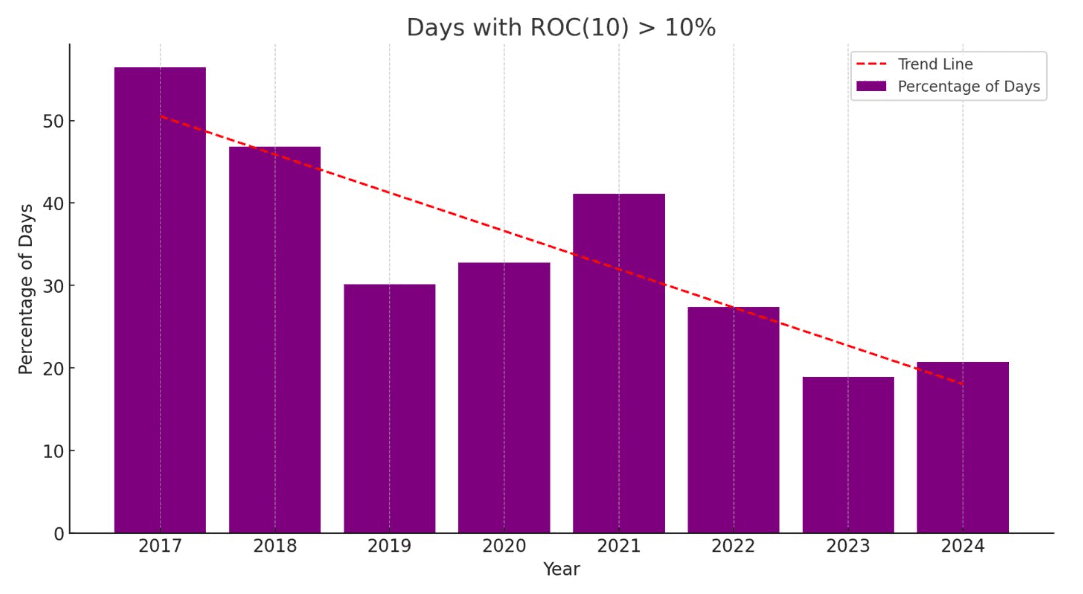
Bitcoin's volatility is declining — a typical sign of asset-class maturation — and its future returns are likely to diminish, following patterns observed in other emerging markets as they mature.
As shown in Figure 1, the percentage of 10-day periods each year with returns above 10% has fallen sharply from 2017 to 2024. In 2017, 69.3% of 10-day periods delivered returns of 10% or more, compared to only 22.2% in 2024. This declining volatility suggests that Bitcoin's extraordinary early-stage returns are unlikely to be repeated at the same magnitude.
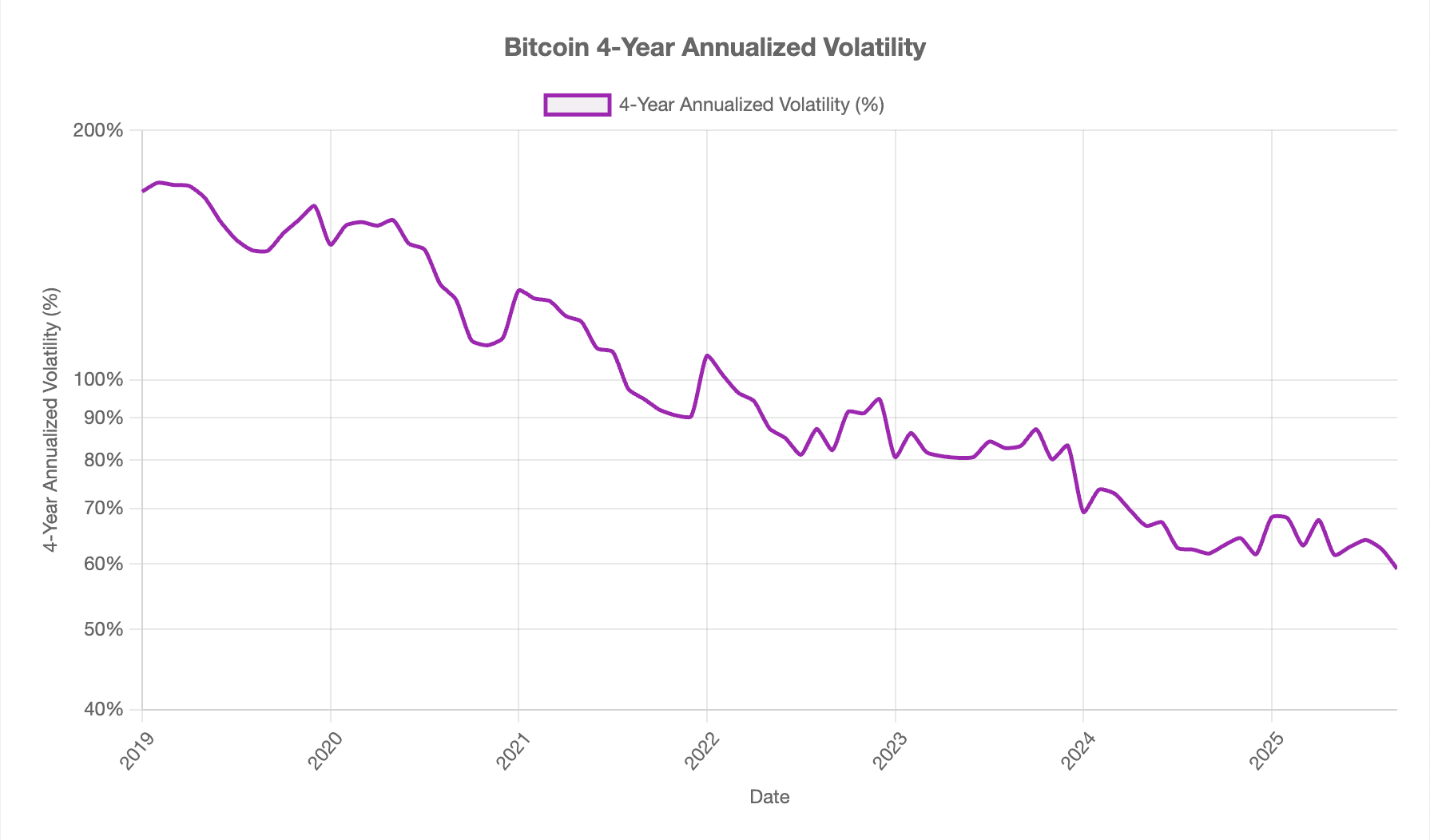
This trend is further confirmed by Bitcoin's steadily declining 4-year annualised volatility, which has fallen from over 180% in early 2019 to approximately 60% by late 2025. As volatility compresses, the magnitude of potential returns naturally diminishes, signalling Bitcoin's evolution from a high-growth speculative asset to a more mature digital store of value.
The buy-and-hold trap in broader crypto
In search of similar outsized gains, many participants have turned to the broader crypto market. Yet most approach it incorrectly. While buy-and-hold strategies may be acceptable for Bitcoin (despite severe drawdowns), they fail almost entirely when applied to the broader crypto universe.
Consider this stark example: a basket purchase of the 20 largest cryptocurrencies at the market peak in late 2021 would have seen only three coins recover to positive returns by July 2025. The majority suffered deep drawdowns exceeding 70%, with many losing over 90% of their value.
Table 1: Performance of buy-and-hold on Top 20 coins from late 2021 (1/11/2021 – 1/7/2025)
| Coin | Return | Coin | Return |
|---|---|---|---|
| XRP | 98.54% | BTC | 74.28% |
| BNB | 25.22% | XLM | -36.14% |
| DOGE | -35.53% | SOL | -23.44% |
| LINK | -58.39% | ETH | -43.40% |
| ADA | -72.21% | ETC | -67.76% |
| SHIB | -83.40% | FTM | -87.98% |
| AVAX | -72.05% | VET | -84.41% |
| ATOM | -88.75% | MATIC | -90.41% |
| ALGO | -89.82% | DOT | -92.04% |
| XTZ | -91.41% | LUNC | -100.00% |
The picture is even starker when examining the Top 50 Binance Futures Index — a daily-rebalanced, equally weighted basket of the top 50 crypto futures. As illustrated in Figure 3, most cryptocurrencies never recover from major drawdowns and eventually trend toward zero.
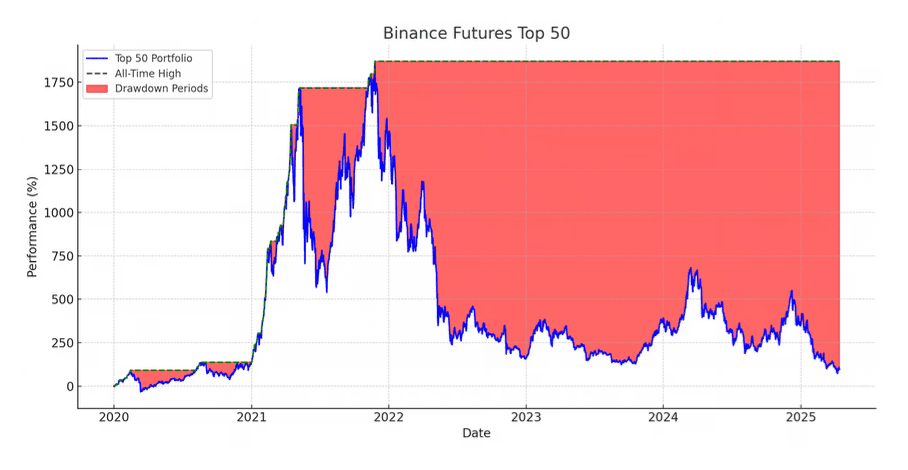
Buy-and-hold strategies may work for Bitcoin, but they have been consistently capital-destructive in the broader crypto market. Identifying future winners is extremely difficult, and the cost of being wrong is severe — often resulting in permanent capital loss.
While Bitcoin's returns gradually diminish, the broader crypto market continues to exhibit high volatility and structural inefficiencies, which open the door for a fundamentally different approach.
The Opportunity
While buy-and-hold has proven ineffective for broader crypto, the same characteristics that make it unsuitable for passive participation — extreme volatility, persistent market inefficiencies, and emotionally-driven participants — make this market environment highly attractive for systematic approaches.
Volatility is opportunity
Crypto remains one of the most volatile and inefficient asset classes globally. Daily price movements of the top 50 Binance-listed futures contracts are often 5–10× larger than those of major equity indices such as the S&P 500. This elevated volatility creates frequent price dislocations and short-term momentum patterns that quantitative strategies can systematically exploit.
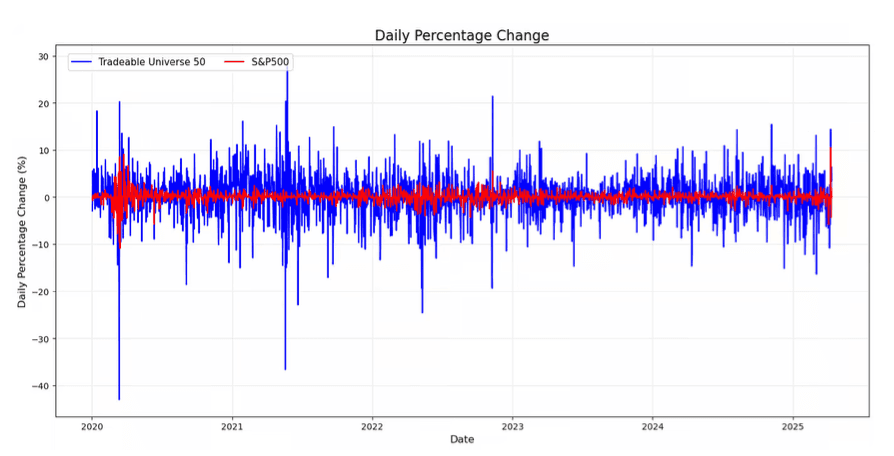
For passive participants, volatility represents risk. For systematic strategies, volatility represents opportunity. Larger price swings generate more frequent and more actionable trading signals, while the crypto market's structural inefficiencies persist far longer than in mature markets.
Ranking by relative momentum
An important factor beyond overall volatility is the magnitude of relative performance during market trends. During major market moves, smaller crypto assets tend to significantly outperform larger ones, and ranking assets by relative momentum amplifies this effect even further, as shown in Figure 5.
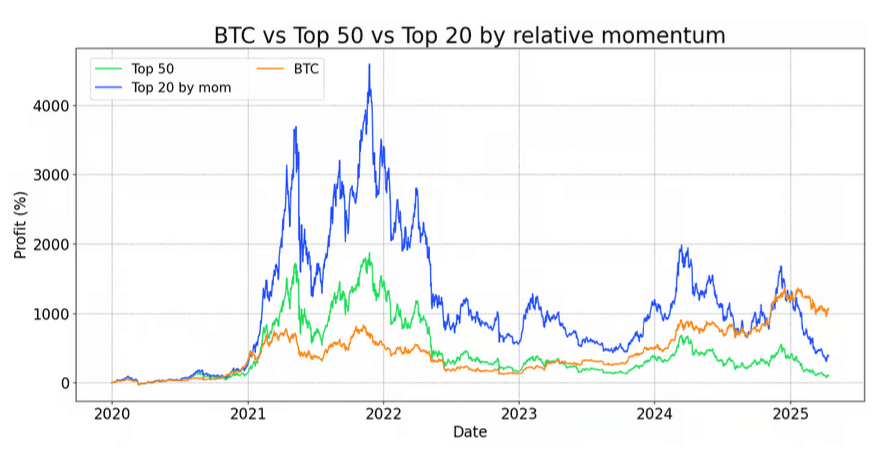
This combination of high volatility, structural inefficiencies, and behavioural mispricings creates a rare and time-sensitive window for systematic strategies to capture short-term dislocations before the crypto market matures further and these inefficiencies diminish.
Our Approach
Robuxio's trading engine is designed to provide unbiased, market-regime-agnostic exposure to the cryptocurrency market — capable of operating across both bull and bear conditions. Rather than relying on any single approach, the engine supports a diversified set of more than twenty uncorrelated strategies, built around two of the most consistently observed edges in crypto trading.
Momentum (long & short)
Captures upside breakouts and hedges against downward trends. Exploits the strong momentum effect observed in crypto markets.
Mean reversion (long & short)
The most stable edge in crypto: profits from short-term overreactions and provides stability during non-trending market conditions.
Strategy development and validation
Given the limited historical data available for crypto futures, each strategy is grounded in decades of validated out-of-sample performance from traditional finance, adapted specifically for crypto market dynamics and continuously monitored under live trading conditions.
Benchmark models are maintained for each targeted market behaviour to validate that live strategy performance aligns with expected outcomes. When live results diverge materially from expectations, the engine's operators investigate whether the model is accurately capturing the intended market behaviour and make appropriate adjustments.
Dynamic universe selection
To eliminate selection bias and ensure robust results, all strategies operate on a dynamic universe of the top 50 USDT-settled crypto futures. This universe is reconstituted daily based on volume and liquidity thresholds, ensuring:
- Tradability: only highly liquid instruments are eligible for positions.
- Bias-free selection: no hindsight or selection bias in universe construction.
- Market representation: captures the most actively traded crypto assets.
- Adaptability: the universe evolves with changing market structure.
The Trading Engine
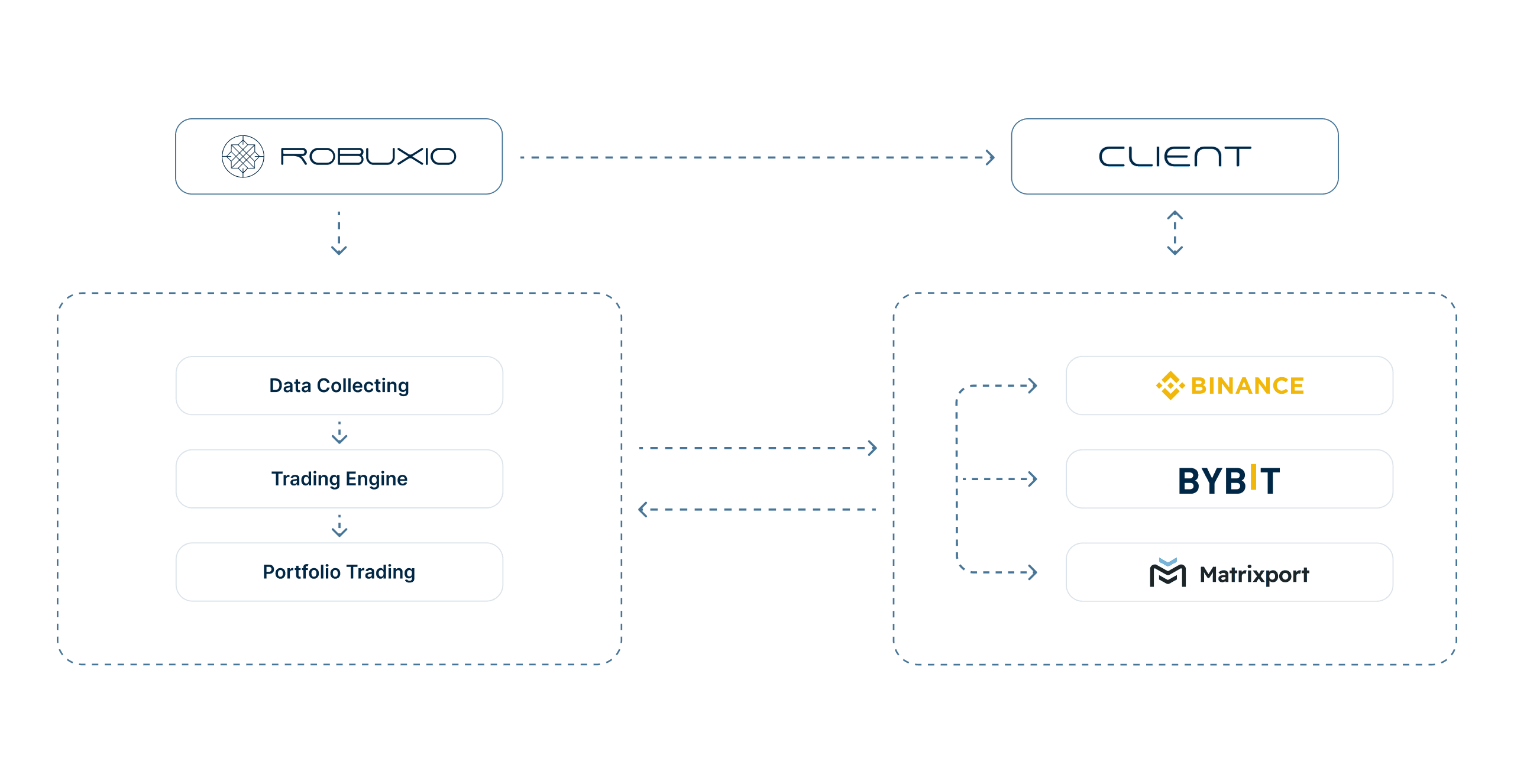
At the core of Robuxio s.r.o.'s offering is a proprietary, fault-tolerant trading engine that executes more than twenty uncorrelated, rule-based strategies across a dynamic universe of highly liquid USDT-settled crypto futures. The engine replaces manual fragility with robust execution and scales to thousands of independent portfolios without compromising discipline.
Architecture and execution
The engine ingests continuous market data streams. Strategy models evaluate recent and historical context to generate entry and exit instructions. These instructions are broadcast to independent, portfolio-level trading agents. Each agent adapts sizing and constraints to its portfolio's bankroll and policy, ensuring consistent logic with portfolio-specific execution.
Execution is liquidity-aware. Orders are sliced, paced, and offset as needed to reduce footprint, preserve fill quality, and remain robust during periods of elevated volatility. Agents run in parallel, allowing thousands of portfolios to operate concurrently under common global rules while remaining isolated from one another.
Only assets that meet predefined liquidity thresholds are eligible for long or short positions. The tradable universe is reconstituted daily from the currently liquid USDT-settled futures, ensuring eligibility reflects live market liquidity and remains bias-free.
Operational safeguards
A pre-trade risk router validates every instruction before any order is sent. Checks include exposure limits, collateral rules, instrument allow-lists, and venue health. A 24/7 live monitoring layer supervises orders, fills, connections, and data coherence. It detects and corrects anomalies — failed settlements, API disruptions, or state mismatches — and maintains alignment through automatic reconciliation and autosync.
Performance & latency
Core processes run on a high-throughput, low-latency stack and are deployed in close proximity to primary exchange infrastructure. This reduces instruction-to-execution delay and preserves reliability during extreme market conditions.
Security & isolation
The trading engine runs entirely within a private network, with no public access. Sensitive systems, internal tools, and execution pathways are not exposed to the public internet. Portfolio state and execution records reside behind strict traffic management and access controls designed for low-latency reads/writes under load, ensuring the database remains responsive even at scale.
Risk Management Philosophy
Risk management forms the foundation of the systematic approach embedded in the engine — designed to protect capital from both market-wide drawdowns and idiosyncratic cryptocurrency failures (the two largest tail risks in any crypto exposure).
Market-wide risk mitigation
- Directional diversification: market-wide drawdowns are addressed through combined long and short exposure across the broader strategy set. The engine supports more than twenty uncorrelated trading approaches designed to generate returns in both bullish and bearish regimes, limiting directional exposure to any single market trend.
- Strategy correlation management: strategies are selected based on rigorous correlation analysis during development, with ongoing systematic monitoring. Risk-adjusted outcomes improve and drawdown periods shorten when a large set of uncorrelated strategies is traded together.
- Regime detection: regime-change detection identifies when market conditions shift significantly, allowing strategies to take new positions only in favourable market conditions.
Single-asset risk controls
- Position sizing: each individual trade represents only a small fraction of total portfolio capital, ensuring that no single position can cause significant portfolio damage.
- Diversification requirements: the dynamic universe approach ensures exposure remains spread across many liquid assets, reducing concentration risk and the impact of any isolated asset failure.
- Catastrophic loss protection: black-swan stop-loss mechanisms protect against extreme adverse moves, protocol exploits, exchange delistings, or liquidity collapses.